Free Shipping over $75 within the contiguous US

More Information

Carrying cloths, like bags, have many pre-Hispanic antecedents. They are square, and are used by placing the contents in the center, then folding two diagonally opposite corners over the contents, and then tying the remaining corners together. They are made in a variety of size for different kinds of goods. Relatively few weavers know how to make these cloths. Textiles with dovetailed-warp joins are known from pre-Hispanic times, often with more elaborate designs. Although this technique does not appear to be part of the Inca style, it was probably used in nearby highland areas about which we have little archaeological information.

Product Origin

Q'ero

Q'ero

Q'ero Nation of Peru 

The Q'ero Nation is located a one day ride on horseback from the road to Paucartambo in Cusco and is the oldest in the Inca Tradition. They live 4,300 meters high in the Peruvian Andes. They grow and eat potatoes, such as olluco and oca. Children between the ages of 7-14 attend school. Medical assistance is scarce. They work and live as a community of 800 or so people. They marry among themselves and have kept their customs alive since Incan times.

The main activity of the Q'ero, besides agriculture, is weaving. They use natural dyes for their wool. Their techniques and designs are considered to be the closest to those of their ancestors. Their weavings have been displayed at the Smithsonian Museum in Washington DC.
The Q'ero believe they are the last descendants of the Inca. According to tradition, their ancestors defended themselves from invading Spanish conquistadores with the aid of the local mountain deities (los Apus) which devastated the Spanish Army near Wiraquchapampa.

The religion of the Q'ero is syncretic, consisting of a mixture of European Christianity with elements of the traditional religion of the Andes. Shamans of different levels (e.g., Altumisayuq, Pampamisayuq) still have a high reputation. They worship Mother Nature (Pachamama) as well as other mountain spirits like Apu Ausangate and other regional deities.

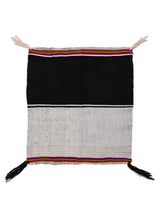
Q'ero Andean Carrying Cloth - Half Design

Fair TradeFair Trade
Hand MadeHand Made
Supports Indigenous CulturesSupports Indigenous Cultures
Regular price $124.00
100% Money Back Guarantee
Like its cousin the despacho cloth, the Q'ero use other plain-woven pieces of cloth to carry goods and food. This cloth is an example of the Q'ero carrying cloth, woven in subtle, natural shades in a half color design. This cloth has a very fine drape and is woven from soft wool, likely alpaca or an alpaca blend. Some also use such cloths on their mesas or altars. Woven in in the high Andes of Peru.
SKU: txd0056

More Information

Carrying cloths, like bags, have many pre-Hispanic antecedents. They are square, and are used by placing the contents in the center, then folding two diagonally opposite corners over the contents, and then tying the remaining corners together. They are made in a variety of size for different kinds of goods. Relatively few weavers know how to make these cloths. Textiles with dovetailed-warp joins are known from pre-Hispanic times, often with more elaborate designs. Although this technique does not appear to be part of the Inca style, it was probably used in nearby highland areas about which we have little archaeological information.

Product Origin

Q'ero

Q'ero

Q'ero Nation of Peru 

The Q'ero Nation is located a one day ride on horseback from the road to Paucartambo in Cusco and is the oldest in the Inca Tradition. They live 4,300 meters high in the Peruvian Andes. They grow and eat potatoes, such as olluco and oca. Children between the ages of 7-14 attend school. Medical assistance is scarce. They work and live as a community of 800 or so people. They marry among themselves and have kept their customs alive since Incan times.

The main activity of the Q'ero, besides agriculture, is weaving. They use natural dyes for their wool. Their techniques and designs are considered to be the closest to those of their ancestors. Their weavings have been displayed at the Smithsonian Museum in Washington DC.
The Q'ero believe they are the last descendants of the Inca. According to tradition, their ancestors defended themselves from invading Spanish conquistadores with the aid of the local mountain deities (los Apus) which devastated the Spanish Army near Wiraquchapampa.

The religion of the Q'ero is syncretic, consisting of a mixture of European Christianity with elements of the traditional religion of the Andes. Shamans of different levels (e.g., Altumisayuq, Pampamisayuq) still have a high reputation. They worship Mother Nature (Pachamama) as well as other mountain spirits like Apu Ausangate and other regional deities.

Fair and ethically traded products Fair and ethically traded products

Offering authentic, sustainable products that support artisans, their families, and indigenous ways

Learn More...
Providing a connection to the sacred arts of indigenous communities Providing a connection to the sacred arts of indigenous communities

Consciously serving our community for over 22 years with integrity and passion

Learn More...

Living in harmony with each other and our earth Living in harmony with each other and our earth

Reducing our use of resources with Earth conscious shipping and packaging practices

Learn More...