
Free Shipping over $75 within the contiguous US


Mestana cloths are wonderful woven expressions of the Peruvian Andean weavers' worldview. Because many traditional weavers believe that all of creation is imbued with spirit, the patterns they weave into their textile goods also express this natural energy and spirit. A mestana cloth, (also sometimes mastana) is a hand woven cloth which has both practical and esoteric purposes. These cloths are typically used to carry belongings, infants, and food. Because of recent publications about the weaving methods of native Peruvians and Bolivians, we now know more about how the textiles are made, usually from native fibers such as alpaca, sheep and llama wool; how the wool is spun into thread and yarn; how the yarn is wound, skeined, plied and dyed, some with natural colors, or synthetic colors or both. The various types of weaving looms used in making textile articles is another whole topic of study in and of itself, as are the weaving techniques, such as the complementary warp technique which produces a piece which is identical on its front and back sides, except for the delightful color reversal of the pattern. There is also a body of knowledge being developed as to how the skill of weaving and knowledge of patterns is passed on from generation to generation. More here on our blog: Mestana Weavings of Peru.

Qero-Nicolas
| Size | 27" L x 26" W |
 Fair Trade
 Hand Made
Q'ero Andean Lliklla Mestana Cloth - Inkarri is backordered and will ship as soon as it is back in stock.
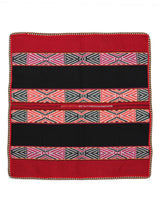
Q'ero traditional mestana cloth featuring the cultural hero of the Inkas, Inkarri. The designs are woven to produce an image with positive color and weave effect on one side and opposite color and weave effect of the same image on the reverse, making it beautiful on both sides. The broad black stripes represent life-giving Pachamama and the two sides of the cloth are joined in the middle with alpaca stitched to represent the mayu or River of the Sky or Milky Way. Finished with the traditional "eye" stitch, which is said to have protective qualities.
Hand woven by Q'ero women living in the high Peruvian Andes. Perfect as a mesa cloth for carrying your sacred stones or as a ground cloth for your personal altar mesa space. Due to the handmade nature of the cloth yours may vary slightly from the photo.
Mestana cloths are wonderful woven expressions of the Peruvian Andean weavers' worldview. Because many traditional weavers believe that all of creation is imbued with spirit, the patterns they weave into their textile goods also express this natural energy and spirit. A mestana cloth, (also sometimes mastana) is a hand woven cloth which has both practical and esoteric purposes. These cloths are typically used to carry belongings, infants, and food. Because of recent publications about the weaving methods of native Peruvians and Bolivians, we now know more about how the textiles are made, usually from native fibers such as alpaca, sheep and llama wool; how the wool is spun into thread and yarn; how the yarn is wound, skeined, plied and dyed, some with natural colors, or synthetic colors or both. The various types of weaving looms used in making textile articles is another whole topic of study in and of itself, as are the weaving techniques, such as the complementary warp technique which produces a piece which is identical on its front and back sides, except for the delightful color reversal of the pattern. There is also a body of knowledge being developed as to how the skill of weaving and knowledge of patterns is passed on from generation to generation. More here on our blog: Mestana Weavings of Peru.
Qero-Nicolas
| Size | 27" L x 26" W |

Q'ero Andean Lliklla Mestana Cloth - Inkarri

Q'ero Andean Lliklla Mestana Cloth - Inkarri is backordered and will ship as soon as it is back in stock.
 Fair and ethically traded products
Offering authentic, sustainable products that support artisans, their families, and indigenous ways
Learn More... Providing a connection to the sacred arts of indigenous communities
Consciously serving our community for over 22 years with integrity and passion
Learn More... Living in harmony with each other and our earth
Reducing our use of resources with Earth conscious shipping and packaging practices
Learn More...
Q'ero traditional mestana cloth featuring the cultural hero of the Inkas, Inkarri. The designs are woven to produce an image with positive color and weave effect on one side and opposite color and weave effect of the same image on the reverse, making it beautiful on both sides. The broad black stripes represent life-giving Pachamama and the two sides of the cloth are joined in the middle with alpaca stitched to represent the mayu or River of the Sky or Milky Way. Finished with the traditional "eye" stitch, which is said to have protective qualities.
Hand woven by Q'ero women living in the high Peruvian Andes. Perfect as a mesa cloth for carrying your sacred stones or as a ground cloth for your personal altar mesa space. Due to the handmade nature of the cloth yours may vary slightly from the photo.
